
The wolf cut with bangs is one of the most expressive haircuts you can get right now. It takes the already bold, shaggy wolf cut and pushes it further by adding a bang that changes the entire frame of your face. Whether you want a curtain bang that softens the look or a blunt fringe that makes a hard statement, there is a version of this combination that suits your hair type, face shape, and personal style. This cut works across all lengths, from short jaw-grazing styles to long layers that reach the waist. It suits straight hair, wavy hair, curly hair, and everything in between. Most importantly, it is a cut that looks intentional even when it is completely unstyled. This list covers 23 creative wolf cut with bangs ideas, each one with practical advice on how to get the look, style it at home, and make it work for your everyday life. If you’re also exploring Butterfly Wolf Cut Ideas, blended layers, feathered volume, and face-framing pieces combine the softness of a butterfly cut with the edgy texture of a wolf cut, creating a trendy, airy hairstyle full of movement and dimension.
1. Wolf Cut with Heavy Curtain Bangs

Heavy curtain bangs are the most popular bang choice for the wolf cut. They are long, center-parted, and sweep softly to each side of the face. The combination with a wolf cut is a natural fit because both styles share the same layered, feathered DNA.
The heaviness of the bangs creates a stronger visual frame around the face compared to lighter, more wispy versions. This suits people who want the curtain bang to be a real feature rather than a subtle accent.
Ask your stylist to cut the bangs with a point-cutting technique rather than a blunt scissor cut. This softens the edges and makes the bangs blend into the rest of the wolf cut layers naturally.
Keep the bangs at cheekbone length for the most flattering result. Shorter bangs can look disconnected from the wolf cut layers. Longer bangs blend more seamlessly.
At home, blow-dry curtain bangs with a small round brush. Direct each side away from the center and slightly downward. This sets the sweep and keeps the bangs flat against the forehead rather than sticking out.
Dry shampoo at the roots of the bangs on day two adds grip and prevents them from going flat or greasy.
Heavy curtain bangs suit almost every face shape. They are one of the most universally flattering bang styles available.
2. Wolf Cut with Blunt Straight-Across Bangs
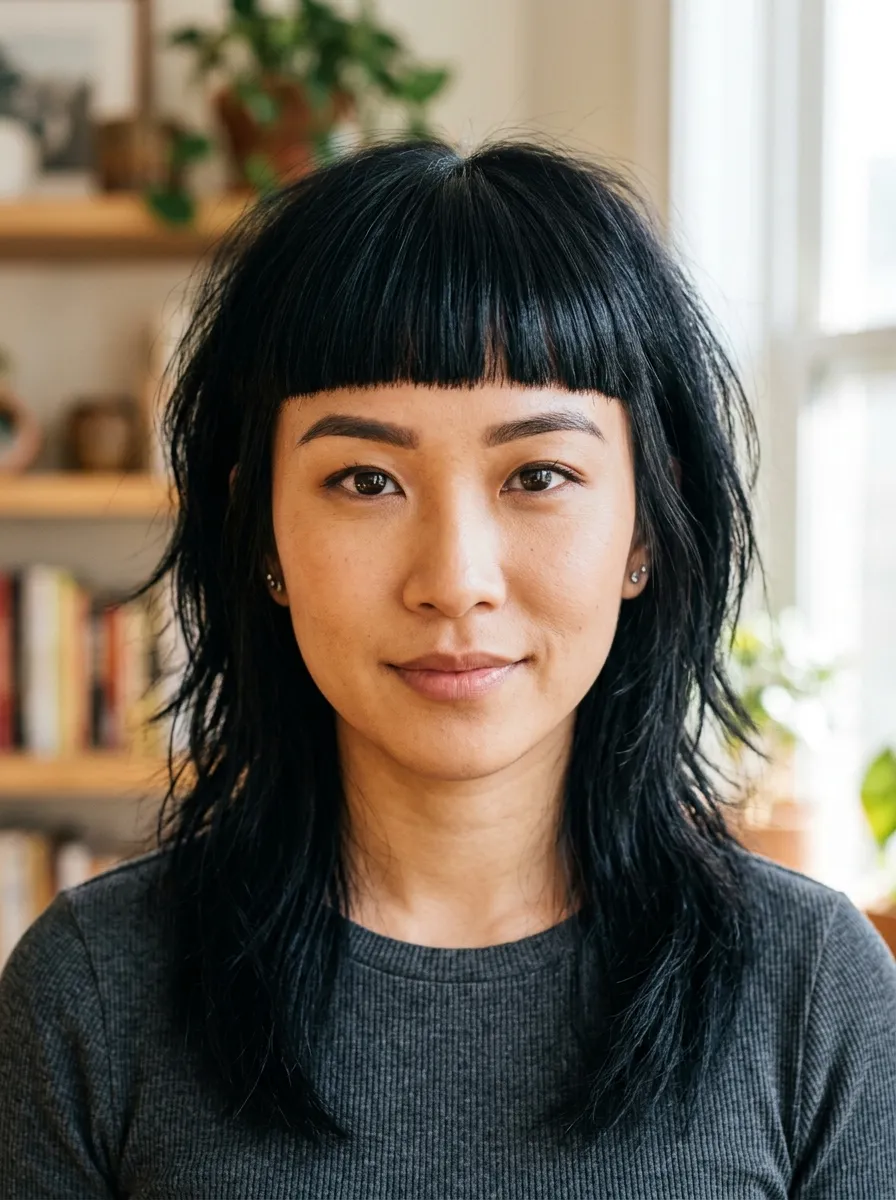
Blunt straight-across bangs on a wolf cut make an immediate statement. Where curtain bangs soften the look, blunt bangs create a sharp, graphic edge that adds real attitude.
The contrast between the hard horizontal bang line and the choppy, shaggy wolf cut layers behind it is what makes this combination so striking.
This look suits people who want their haircut to have a deliberate, high-fashion quality. It is not a subtle style. It commands attention.
The bangs sit best just at or slightly above the eyebrow. Any longer and they start to look like curtain bangs. Any shorter and they can look too severe for everyday wear.
Blunt bangs require more regular maintenance than curtain bangs. Plan for a trim every three to four weeks to keep the blunt line clean and precise.
At home, use small sharp scissors to trim blunt bangs between salon visits. Cut in a straight line while the bangs are dry, taking off a tiny amount at a time. Cutting too much at once is the most common DIY mistake.
Style blunt bangs by blow-drying them straight down with a flat brush. A light mist of hairspray keeps the line crisp without making the bangs stiff.
This combination works best on straight or slightly wavy hair. Very curly or wavy bangs may not hold a straight blunt line without daily straightening.
3. Wolf Cut with Wispy Bangs for a Soft Edge

Wispy bangs are the lightest, most delicate bang option for the wolf cut. They sit across the forehead as a thin veil of hair rather than a solid fringe. The effect is soft, effortless, and very wearable.
This style suits people who want the look of bangs without committing to the full density of a traditional fringe. If you have ever been nervous about cutting bangs, wispy bangs are the safest starting point.
Ask your stylist to take only a small amount of hair from the front section for wispy bangs. The sparseness is what creates the effect. Too much hair and they become regular bangs.
Wispy bangs are also created by point-cutting all the way through the bang section, removing significant weight and creating gaps between strands.
These bangs are very forgiving as they grow out. Because they are already thin, they simply become slightly longer face-framing pieces rather than looking obviously overgrown.
Style them with a light-hold mousse or leave them completely unstyled. Wispy bangs often look their best with zero product.
They suit all face shapes well. On wider or rounder faces, slightly longer wispy bangs that extend to the cheekbone frame the face more flatteringly than short ones sitting at mid-forehead.
Wavy and straight hair both suit wispy bangs equally well. Curly hair may need straightening to show the bang effect clearly.
4. Wolf Cut with See-Through Bangs

See-through bangs are even more minimal than wispy bangs. They are so thin and sparse that the forehead shows clearly through them. The effect is delicate, almost accidental-looking, and very current.
This style is popular in Korean and Japanese hair trends and has crossed over into Western salons widely. It suits a clean, minimal aesthetic beautifully.
The key is taking very little hair for the bang section. The stylist uses only a thin layer from the very top front section and point-cuts aggressively through it to remove as much weight as possible.
See-through bangs work best on straight hair. They can be achieved on wavy hair with a straightening iron, but curly hair generally does not hold this look well without significant daily effort.
These bangs require almost no styling. They fall naturally into place and do not need blow-drying or pinning.
They are also one of the most comfortable bangs to grow out. Because they are so thin, growing them into the rest of the layers is seamless.
See-through bangs suit people with clear, smooth forehead skin as the skin is intentionally visible through the hair.
Pair this style with a precise wolf cut that has clean, well-defined layers for the most polished result. The delicacy of the bangs suits a more refined version of the wolf cut rather than an extremely shaggy one.
5. Wolf Cut with Long Side-Swept Bangs
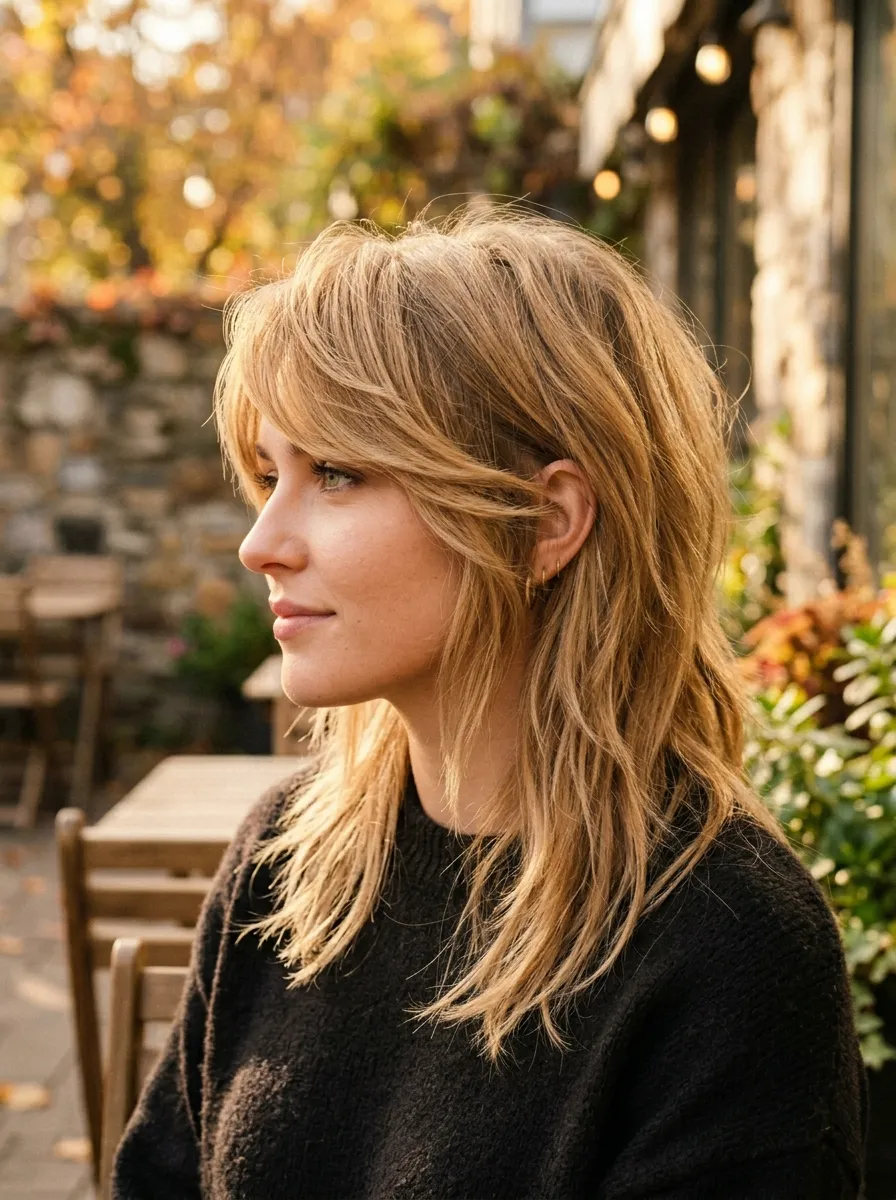
Long side-swept bangs on a wolf cut create a dramatic, asymmetric quality that suits bold and confident personalities. The bangs sweep across the forehead to one side, often reaching past the cheekbone and blending into the face-framing layers.
This version of bangs is less committed than a full fringe. Because they are long and swept, they can be pushed out of the way on days you do not want to deal with them.
The side sweep direction should follow your natural hair growth pattern. Push the bangs in the direction your hair naturally falls. Fighting the natural direction means more daily styling effort.
Ask your stylist to cut these bangs with a gradual angle from short on one side to long on the other. This creates the sweeping movement rather than a uniform length pushed to one side.
Style side-swept bangs with a blow-dryer and a large round brush. Direct the brush in the sweep direction while drying to train the hair into position.
A small amount of light-hold pomade or cream worked through the bang section keeps the sweep in place without looking overdone.
This bang style suits square and round face shapes particularly well. The diagonal line created by the sweep creates an elongating effect.
On a wolf cut, side-swept bangs add a deliberate asymmetry that makes the whole cut look more stylized.
6. Shaggy Wolf Cut with Choppy Bangs
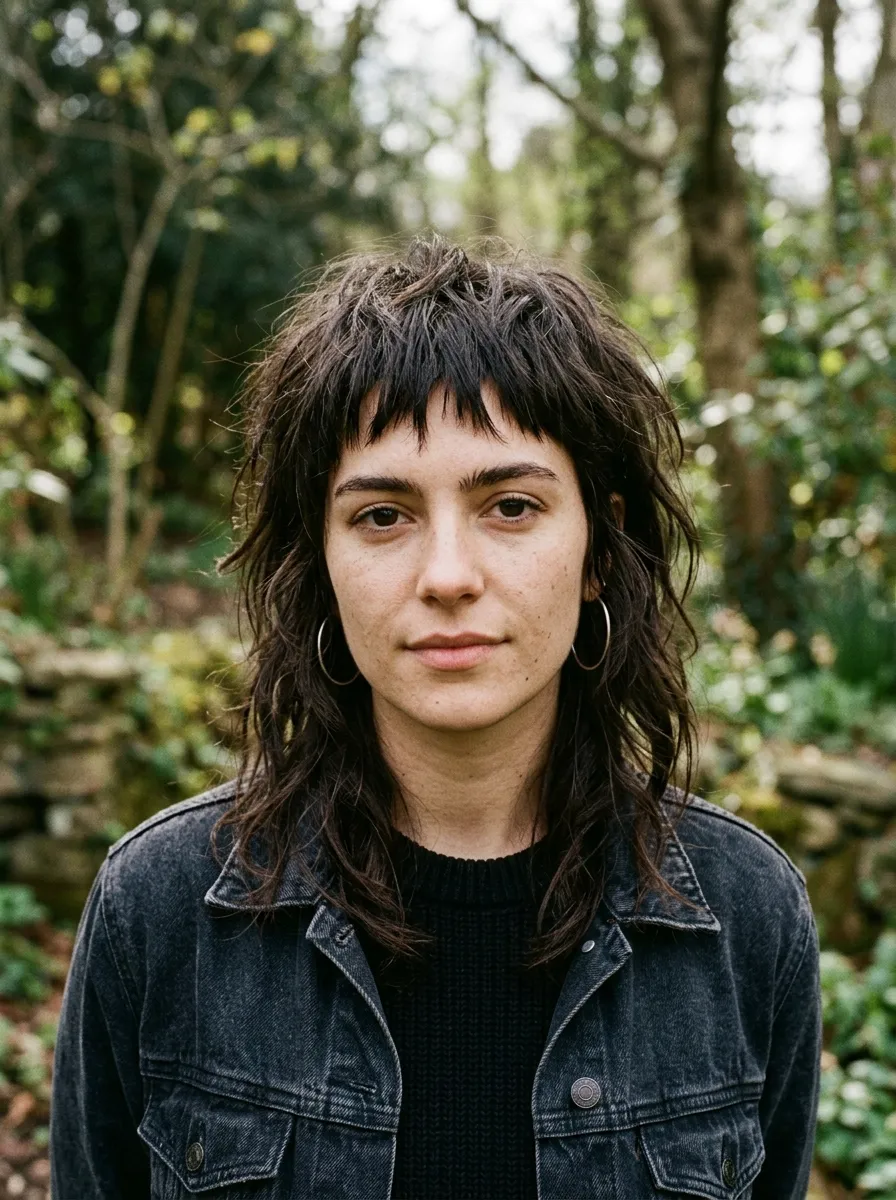
Choppy bangs take the shaggy energy of the wolf cut and apply it directly to the fringe. Instead of a clean, even line, the bangs have irregular lengths, visible notch-cuts, and a deliberately uneven edge.
This gives the entire look a raw, DIY quality that suits people who lean toward alternative or grunge aesthetics.
The unevenness is intentional and the appeal. Ask your stylist to use point-cutting and razor-cutting heavily on the bang section, creating a fractured, textured edge rather than a smooth line.
At home, you can create choppy bangs by taking small diagonal snips into your existing bangs with sharp scissors. Cut at different angles rather than straight across. This breaks up the line without requiring precision.
Choppy bangs are extremely low maintenance because small growth and movement actually adds to rather than detracts from their appearance.
They suit most hair textures. Straight hair shows the choppiness most clearly. Wavy hair gives the choppy bangs a more organic, natural quality.
Style choppy bangs by either leaving them completely unstyled for a raw look or working a tiny amount of pomade through them to define the individual pieces.
Pair this style with dark or muted hair colors like black, deep brown, or dark burgundy to reinforce the edgy quality of the cut.
This is the version for anyone who wants their hair to look like they cut it themselves on purpose, not by accident.
7. Wolf Cut with Bangs on Short Hair
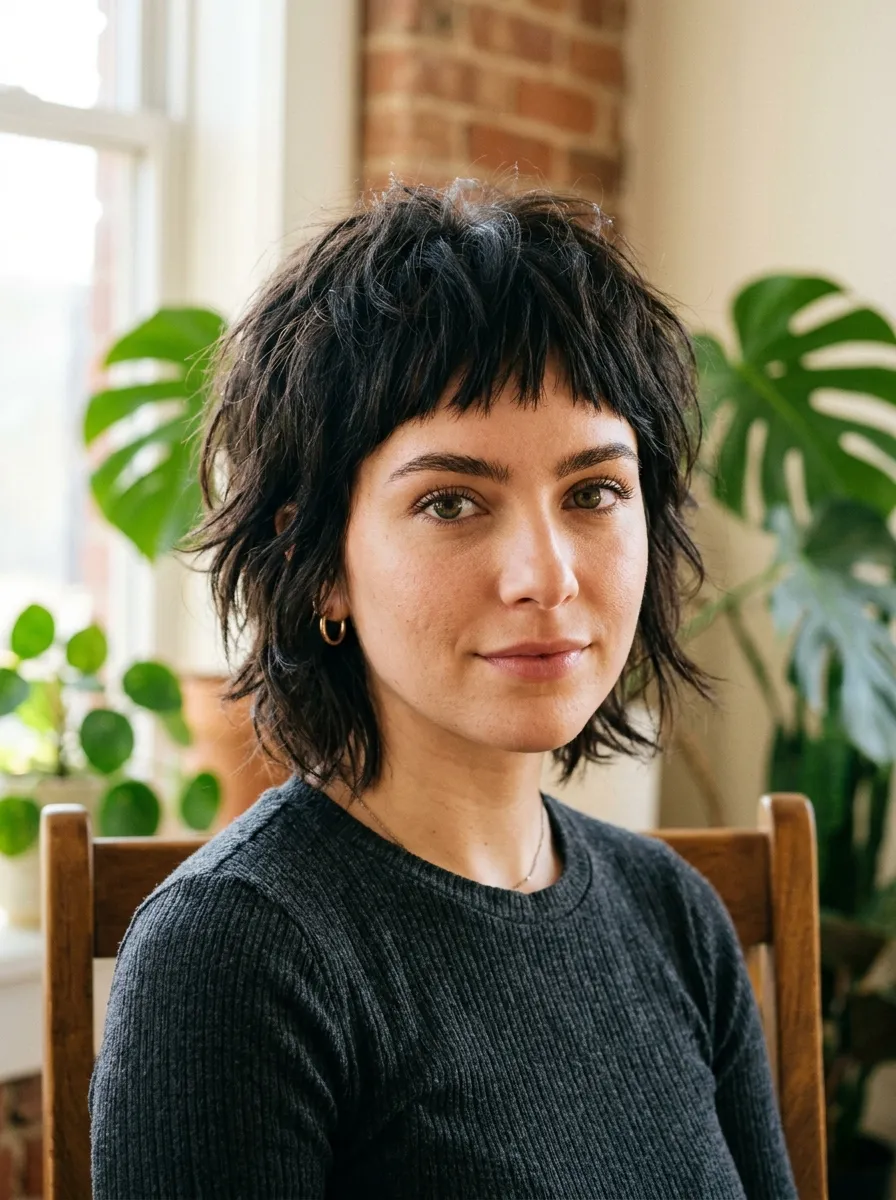
A short wolf cut with bangs is one of the boldest combinations on this list. With the hair length sitting at the jaw or chin, every detail of the cut is visible. The bangs become a central feature of the entire look.
Short wolf cuts with bangs work particularly well for people with fine to medium hair because the layering adds visible volume and texture at a length that could otherwise look flat.
The bangs should be proportional to the overall length of the cut. On a jaw-length wolf cut, bangs that sit at the eyebrow or just above it balance the proportions well.
Very long bangs on a short wolf cut can look too heavy and drag the face down. Keep the bang length at or above the eyebrow for the most balanced result.
This cut requires regular maintenance. Both the bang length and the wolf cut shape need trimming every six to eight weeks to prevent them from losing definition.
Style this look with a texturizing paste worked through the ends and a quick blast with a diffuser to build volume at the crown.
Short wolf cuts with bangs suit oval, heart, and diamond face shapes particularly well. For very round faces, keep the bangs slightly longer and the sides of the wolf cut more voluminous for a lengthening effect.
This is a transformative cut. It completely changes your look in a single appointment.
8. Wolf Cut with Bangs on Long Hair
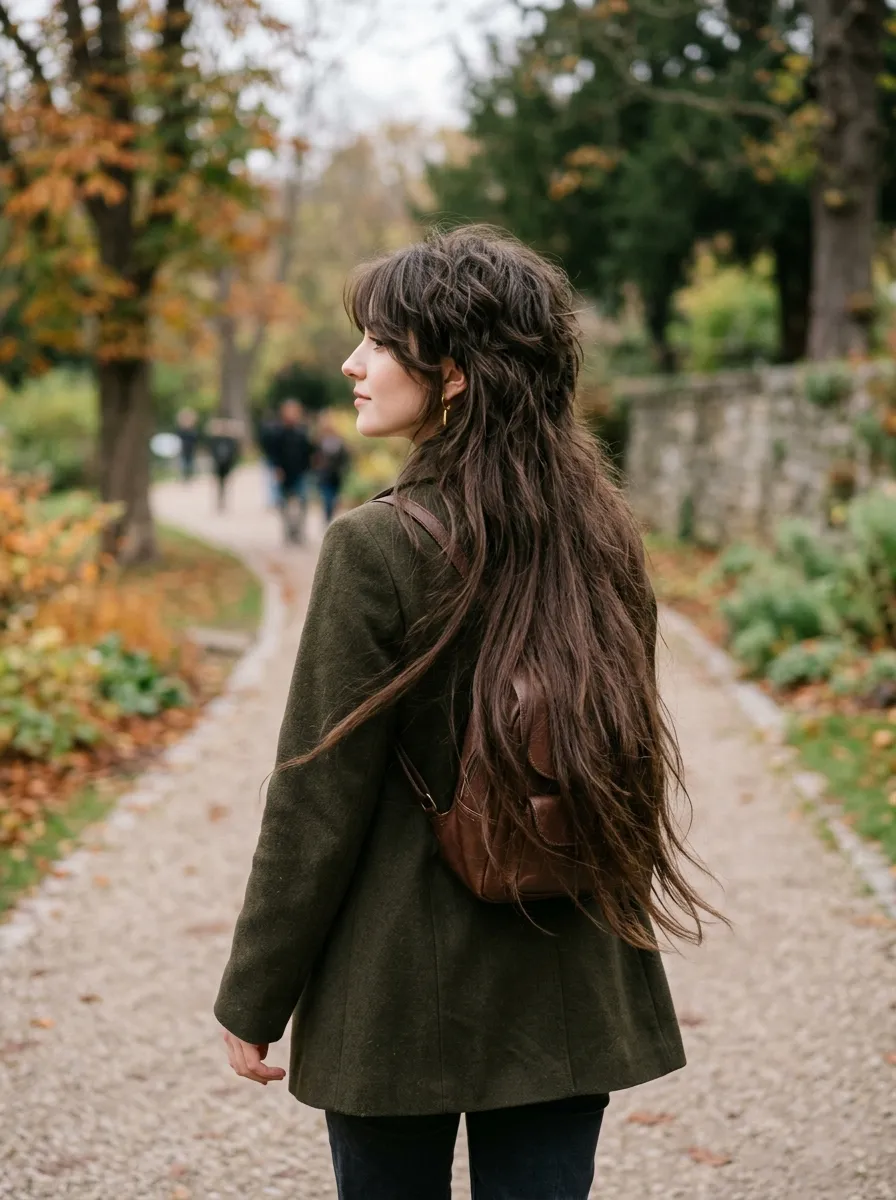
Long hair wolf cuts with bangs create one of the most dramatic silhouettes in current hair trends. The extreme contrast between the short, voluminous crown layers and the long flowing length below is visually arresting.
Adding bangs to this look frames the face and creates a front focal point that anchors the entire style.
Curtain bangs or long side-swept bangs suit long wolf cuts best. They are proportional to the overall length and blend naturally into the face-framing layers.
Very short blunt bangs can look disconnected on extremely long wolf cuts. The abrupt transition from a short fringe to very long layers can feel jarring rather than intentional.
Long wolf cuts with bangs benefit from regular trims at the top layers even if you are growing out the length. The crown layers need refreshing every eight to ten weeks to maintain the volumetric shape.
Use a sea salt spray or texturizing spray through the mid-lengths and ends to prevent long hair from looking weighed down. Apply while damp and let air-dry.
Overnight braids on damp long hair create beautiful waves that suit this cut perfectly. Braid loosely at bedtime and release in the morning.
This is one of the most photogenic haircuts available right now. The combination of the long layers, the voluminous crown, and the face-framing bangs looks stunning from every angle.
9. Wolf Cut with Bangs for Curly Hair
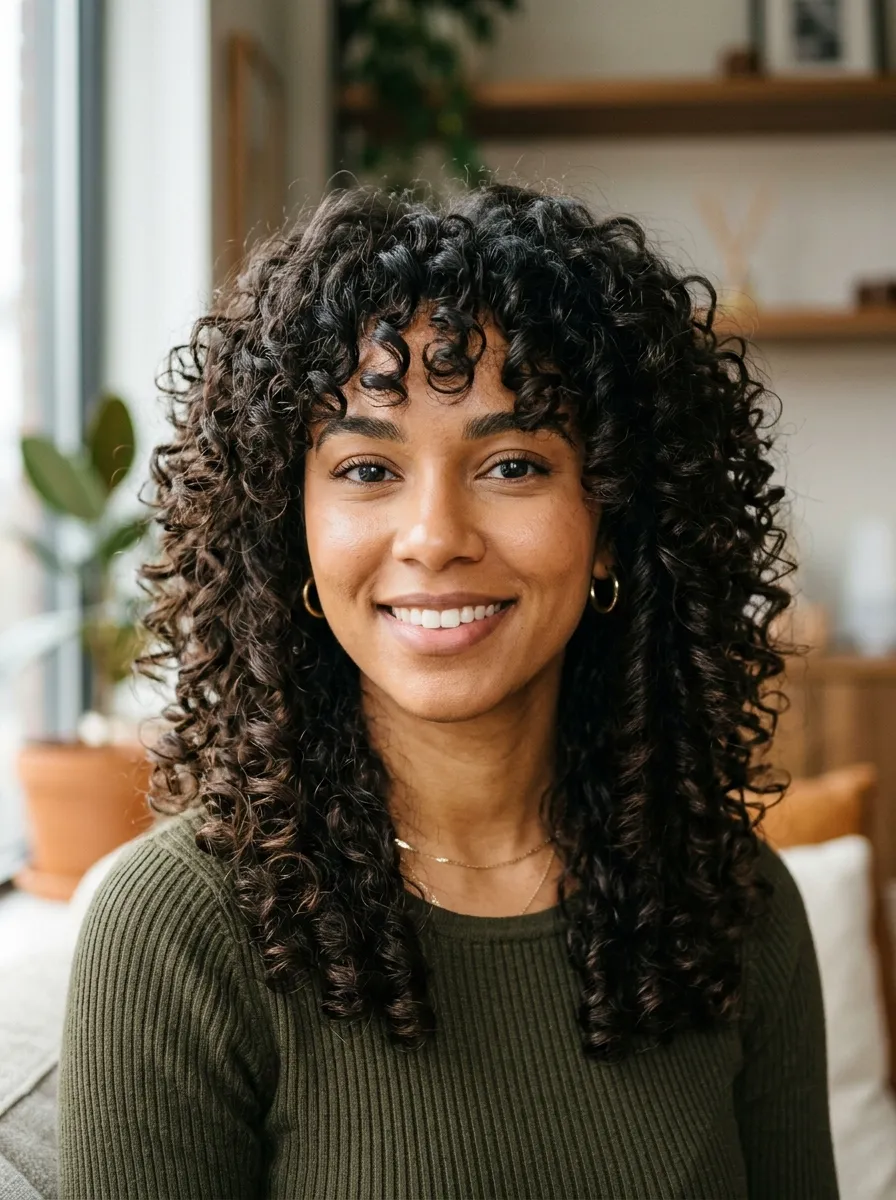
Curly hair wolf cuts with bangs are absolutely stunning and very wearable. The curl pattern adds volume and dimension to every layer, making the wolf cut shape even more pronounced.
Curly bangs behave very differently from straight bangs. They spring up shorter than they appear when wet, so your stylist needs to cut them longer than the target length to account for shrinkage.
Always request that your stylist cut curly bangs dry. Cutting curly hair wet results in unexpected length changes once the curls dry and contract. Dry cutting gives precise control over the final result.
Curtain bangs on curly hair are one of the most flattering options. The curls naturally separate and frame each side of the face beautifully.
Avoid straightening curly bangs daily. This causes heat damage over time and disrupts the natural curl pattern. Embrace the curl in the bang section for a more authentic and healthy look.
Refresh curly bangs by spritzing with water and scrunching in a small amount of curl cream. This reactivates the curl pattern without washing.
On wash days, apply a curl-defining gel or cream to the bangs while wet and either diffuse or air-dry. Avoid touching them while they dry to prevent frizz.
Curly wolf cuts with bangs require almost no daily styling once you find the right product routine for your curl type.
10. Wolf Cut with Bangs for Straight Hair
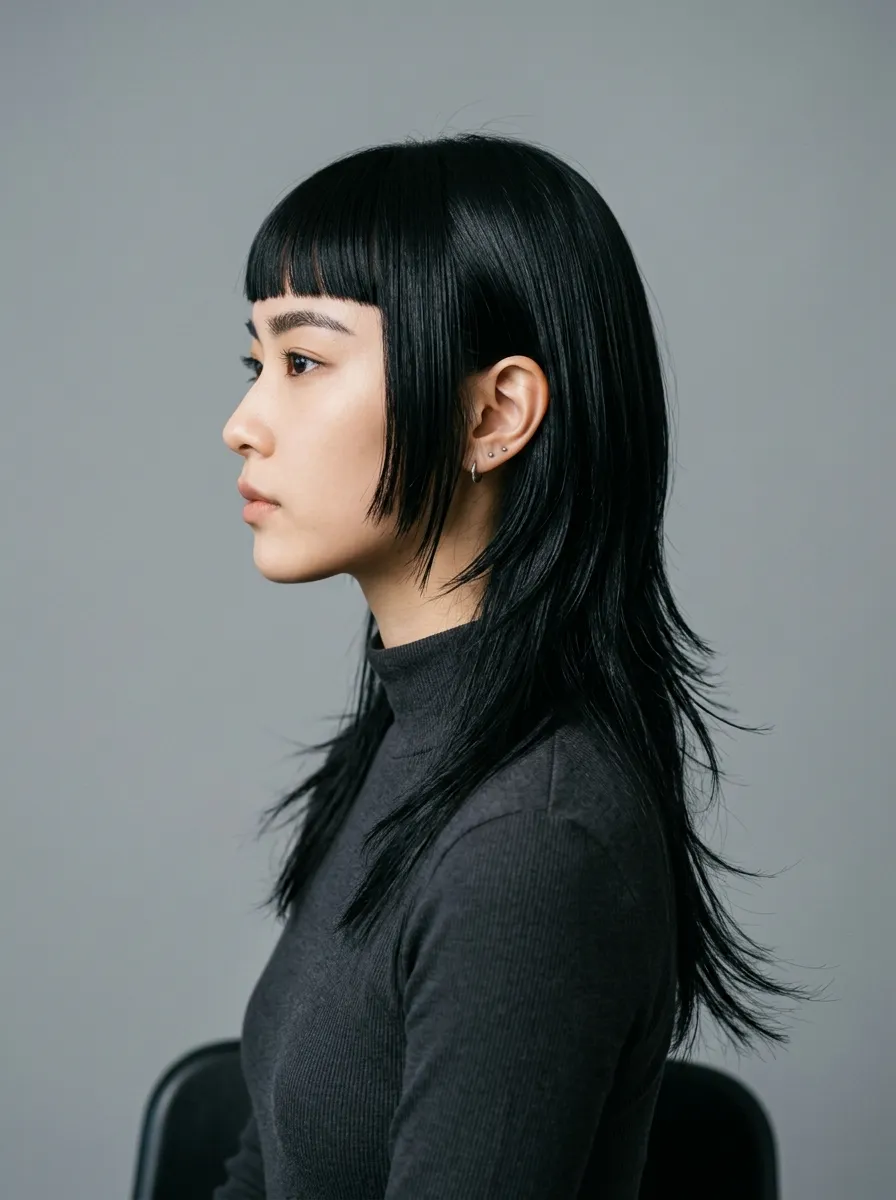
Straight hair showcases the wolf cut with bangs structure more clearly than any other hair type. Every layer, every length change, and every bang angle is visible without the interference of waves or curls.
This clarity can work for you or against you. On a well-executed wolf cut with precise bangs, the structure looks sharp and deliberate. On a poorly executed cut, the flaws also show clearly.
Straight hair wolf cuts benefit from heavy layering to prevent the cut from looking flat. The layers need to be cut aggressively enough to create movement even without natural texture.
Texturizing spray is your best friend with straight hair. Apply it through the mid-lengths and ends before styling to create grip and separation between the layers.
Blunt bangs look especially graphic and clean on straight hair. The straight texture holds the blunt line effortlessly without much daily effort.
Style straight wolf cut layers by blow-drying section by section with a round brush. Direct each layer outward slightly as you dry to build volume and movement.
A light-hold hairspray sets the volume without making straight hair look stiff or overdone.
Consider adding a subtle balayage or highlights to straight hair wolf cuts. Color adds the visual dimension that straight texture cannot provide on its own, making the layers look more defined and interesting.
11. Wolf Cut with Bangs and Layers for Wavy Hair
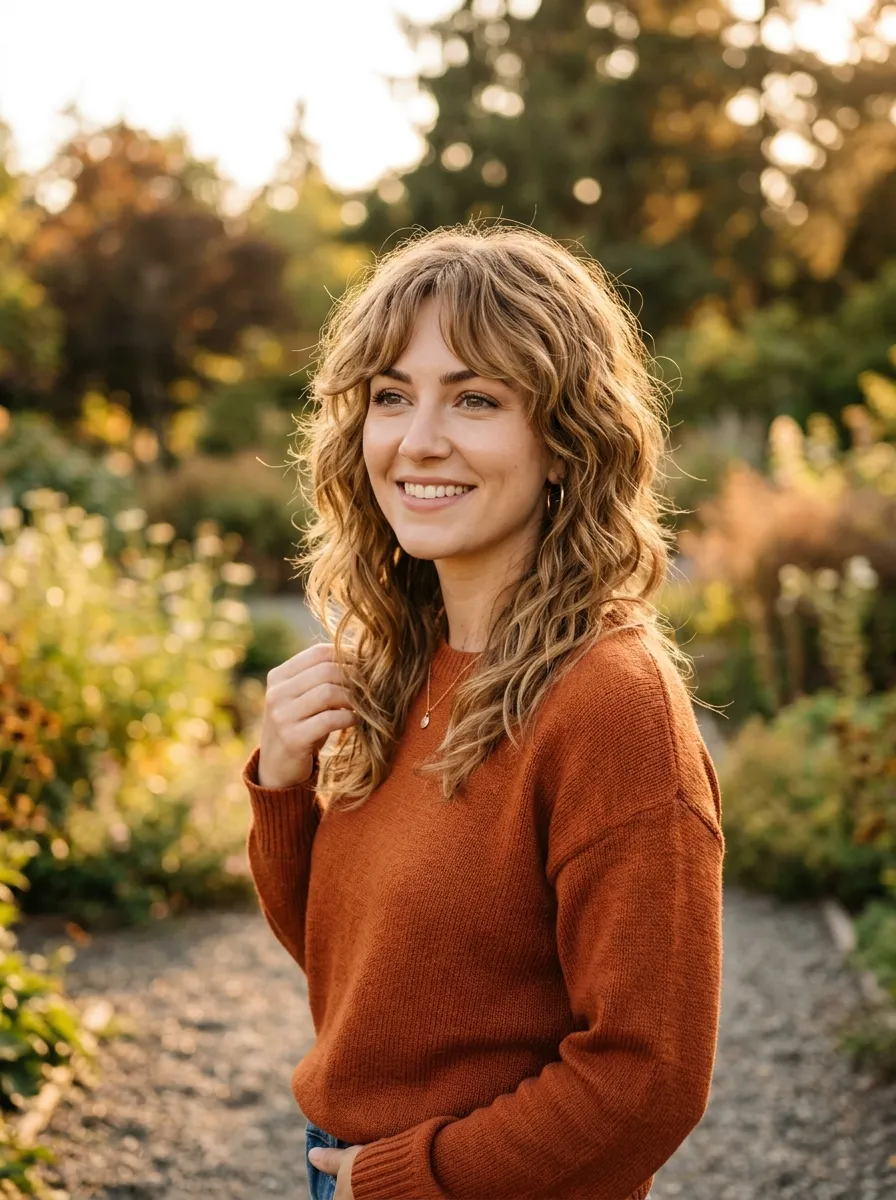
Wavy hair is one of the most flattering textures for the wolf cut with bangs. The natural wave movement fills out the layers, makes the cut look voluminous, and gives the bangs an organic, lived-in quality.
The wolf cut works with wavy hair rather than against it. The layers are cut specifically to allow movement, and natural waves provide exactly that.
Air-drying is the best approach for wavy wolf cuts with bangs. The waves set naturally as the hair dries, filling every layer with texture and movement without any heat styling.
Apply a light styling cream or mousse to damp hair before air-drying. This defines the waves and prevents frizz without weighing the hair down.
Wavy curtain bangs have a slight natural curve that actually makes them look more flattering than perfectly straight ones. Embrace the wave in the bang section rather than fighting it with a straightener every morning.
For days when the waves need a boost, scrunch the hair upward with damp hands to reactivate the wave pattern. A fine mist of water is enough to reset waves that have fallen flat overnight.
Wavy wolf cuts with bangs grow out beautifully. The wave disguises the grow-out phase and the cut continues to look intentional for months after the initial cut.
This combination is genuinely one of the lowest-maintenance looks on this entire list.
12. Wolf Cut with Full Fringe Bangs
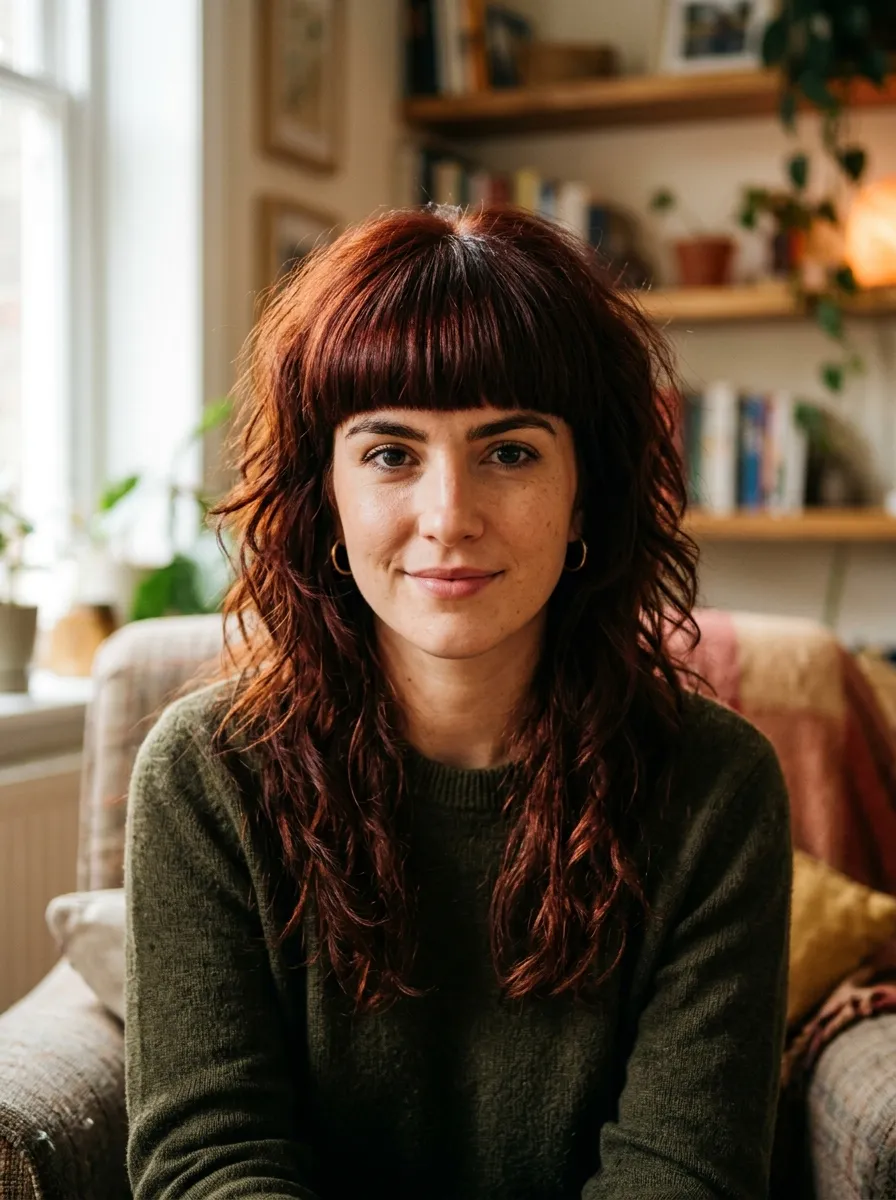
A full fringe on a wolf cut creates maximum contrast and makes the boldest statement of any bang option. The thick, solid line of the fringe frames the face strongly and gives the wolf cut a more structured, deliberate appearance.
This combination suits people who are comfortable with a high-impact look. It is not a style that fades into the background.
A full fringe sits best at eyebrow level or just above. Below the eyebrows, it can feel heavy and cover too much of the face. Above the eyebrows, it can feel too short and severe. Right at the brow line is the sweet spot for most face shapes.
Full fringe bangs require consistent maintenance. They grow out faster than it seems and need trimming every three to four weeks to keep the clean line.
Between salon visits, trim at home using the method of combing the bangs down flat and cutting a tiny amount straight across. Always cut less than you think you need to.
Style a full fringe by blow-drying it straight down with a flat brush until it lies smooth. A boar bristle brush works well for this.
Avoid heavy products on a full fringe. They cause the bangs to look greasy quickly and can contribute to forehead breakouts.
Full fringe bangs suit heart-shaped and oval faces best. They balance a wider forehead by covering it and drawing focus to the eyes.
13. Wolf Cut with Bangs in a Two-Block Style
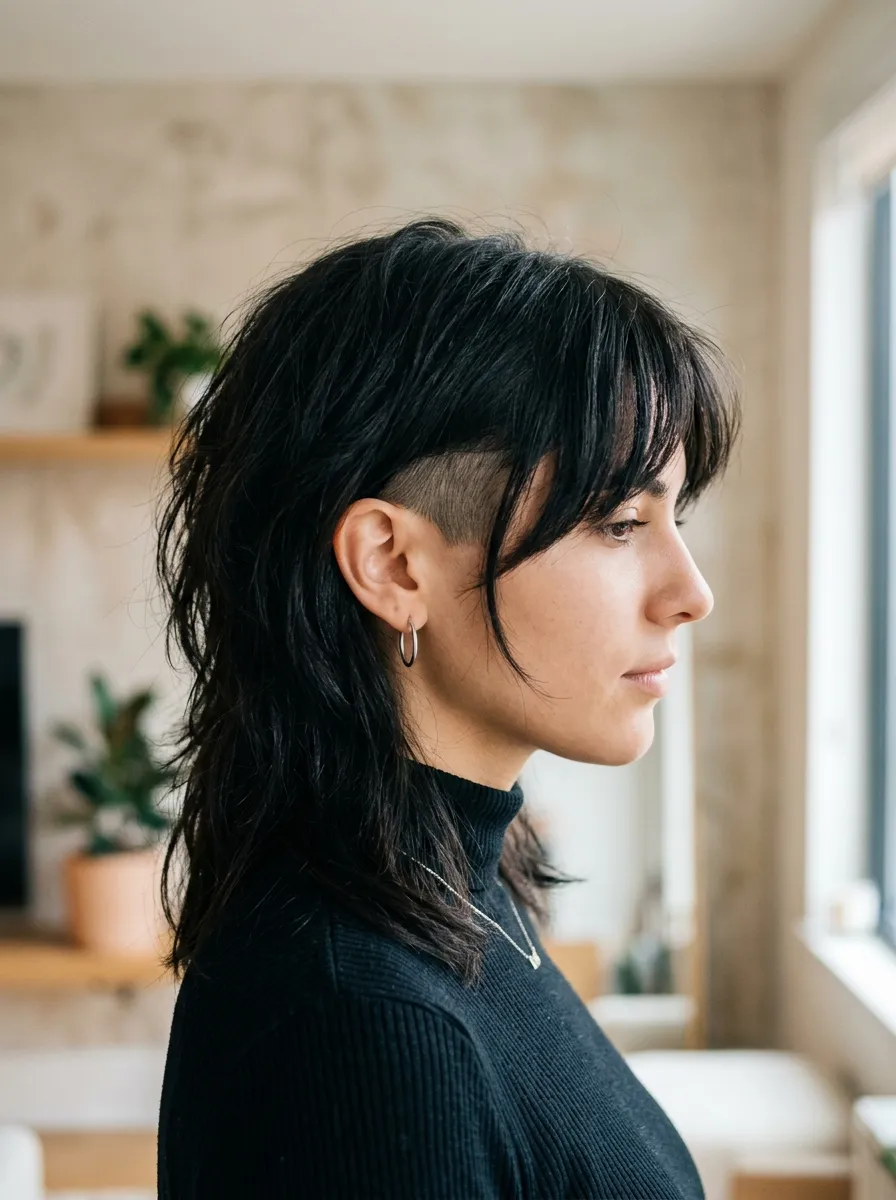
The two-block wolf cut combines the structured contrast of the two-block haircut with the shaggy, layered character of the wolf cut. The sides are cut shorter while the top layers remain long and heavy, falling forward as curtain bangs or long face-framing pieces.
This combination is extremely popular in Korean and East Asian street style. It has since spread globally because the contrast creates a very striking shape.
The key is the disconnect between the shorter sides and the longer top. This contrast is what defines the two-block element. The wolf cut layering is applied exclusively to the top section.
Ask your stylist to keep the sides clean and close, either tapered or scissor-cut to a consistent shorter length. The top layers should then be wolf-cut with heavy layering.
The curtain bangs or forward-falling top pieces act as the bang in this style. They fall directly across the forehead when pushed forward.
Style the top section with a light pomade or styling cream and your fingers. Push the layers forward to show the bang effect or push them back and to the sides for a more open look.
This style works on straight and slightly wavy hair. Very curly hair may not show the two-block contrast as clearly.
It suits oblong and oval face shapes best.
14. Wolf Cut with Bangs and Undercut
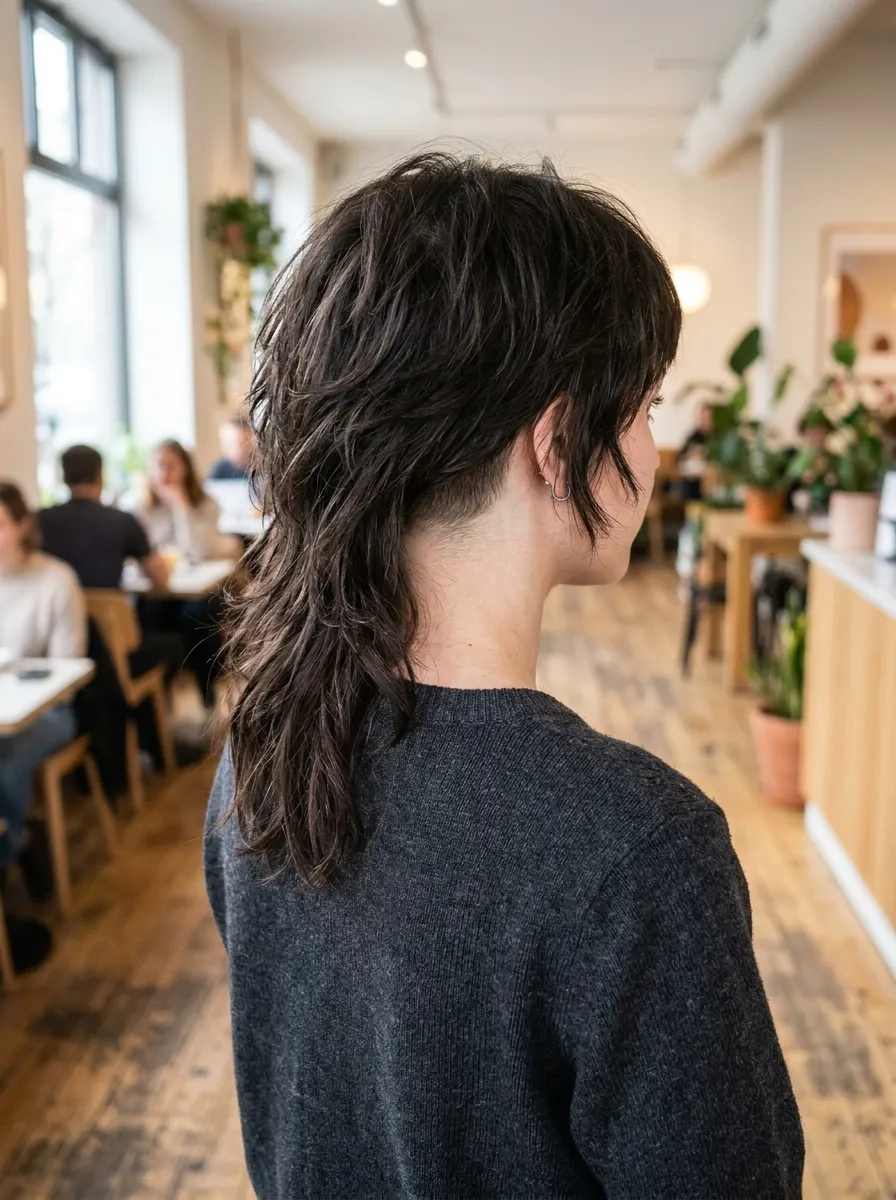
An undercut adds a hidden or partially visible element to the wolf cut with bangs that takes the overall look into fully edgy territory. The nape or sides are cut very short while the wolf cut layers above remain long.
Most of the time, the undercut is hidden under the longer layers. But when the hair is pulled up or blown in the wind, the contrast reveals itself dramatically.
This combination suits people who want a conventional look for work or formal settings and a bolder look the rest of the time. The undercut is hidden or shown depending on how the hair is worn.
Ask your stylist to do the undercut as the last step after completing the wolf cut. This way, the layering is done first and the undercut is then carved underneath.
The undercut can be left natural, buzzed with a clipper to a uniform length, or even patterned with a clipper guard for a decorative effect.
Maintain the undercut by getting it trimmed every four to six weeks. This is the part of the style that shows the most growth most quickly.
The bang in this combination can be anything from curtain bangs to a full fringe. Curtain bangs paired with an undercut create a compelling contrast between delicate front framing and bold structural detail at the back.
15. Wolf Cut with Bangs in Dark Colors for Maximum Impact
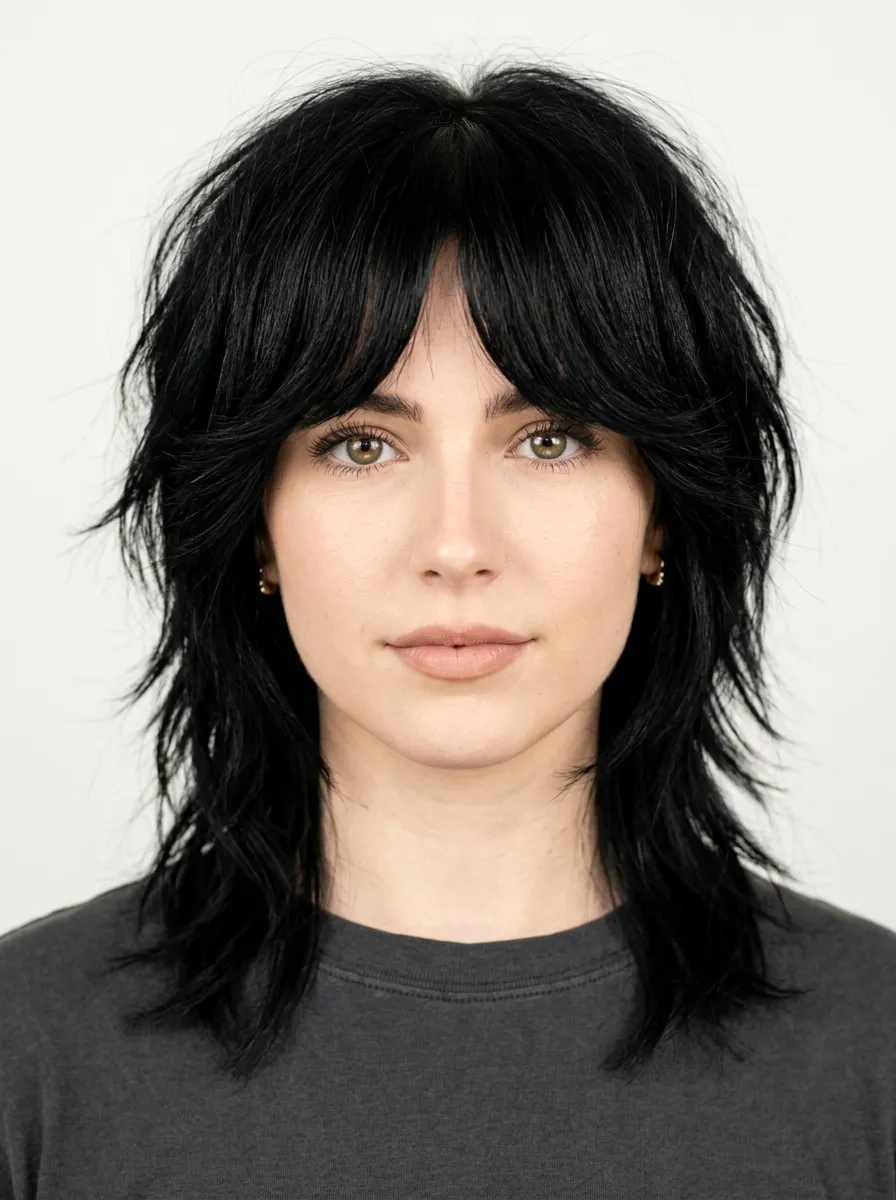
Dark hair colors make the wolf cut with bangs look its most dramatic. Black, deep brown, and dark espresso tones make every layer, every length change, and every bang angle visible and graphic.
The contrast between the dark hair and the skin or eyes is what creates the impact. Nothing adds more visual weight to a haircut than a deep, rich dark color.
Jet black is the most extreme option and creates the highest contrast. It suits cool-toned complexions with pink or olive undertones particularly well.
Deep brown with slightly warmer undertones works beautifully on warm-toned skin. It has all the visual impact of black but feels slightly softer.
Maintaining dark hair color requires a color-safe shampoo to prevent fading. Wash in cool water rather than hot, as heat opens the hair cuticle and accelerates color loss.
A weekly toning treatment helps dark hair that has been colored stay true and prevents it from fading to a dull, washed-out brown.
For natural dark hair, a gloss treatment at the salon every few months adds incredible shine and depth to the color without changing its tone.
Dark wolf cuts with bangs are one of the most consistently photographed styles right now. The combination photographs with extreme clarity and definition.
16. Wolf Cut with Bangs in Bold Fashion Colors
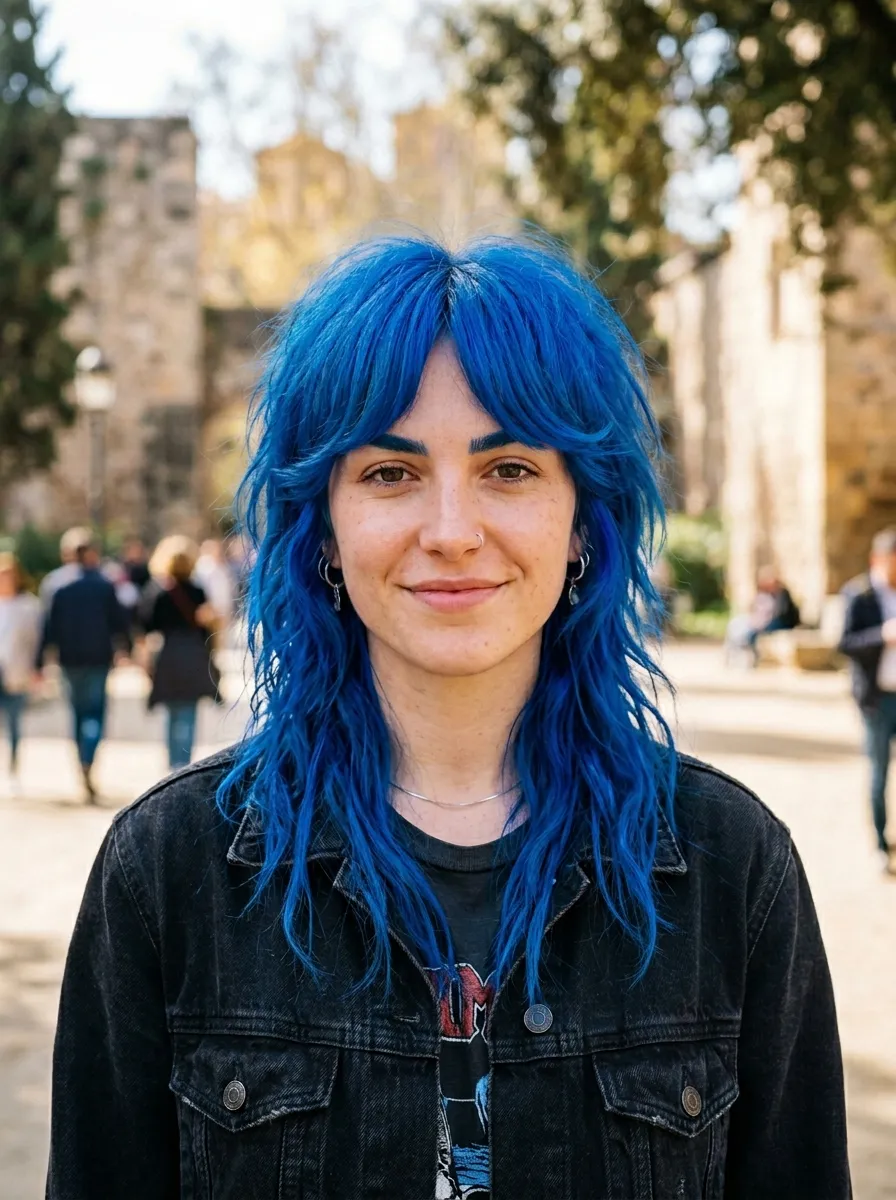
Fashion colors take the wolf cut with bangs into fully expressive territory. Vivid blues, purples, pinks, reds, and greens applied to a wolf cut transform the hairstyle into wearable art.
The wolf cut is one of the best haircuts for showing off bold color because the layering creates so much movement. As the layers shift and separate, the color catches the light from different angles.
Curtain bangs in a matching bold color create a cohesive look that frames the face dramatically. Contrasting colors on the bangs versus the rest of the cut create a more graphic, color-blocked effect.
Fashion colors require pre-lightening for most natural hair shades. This means bleaching the hair before applying the vivid color. This process can be done at home but carries risk of damage if not done carefully.
For a safer approach, have a professional colorist do the bleaching and color application. Look for salons that specialize in vivid color work.
Vivid colors fade faster than natural tones. Expect to refresh the color every four to six weeks to maintain vibrancy.
Use a color-safe, sulfate-free shampoo and wash in cold water only. Hot water strips vivid color dramatically faster.
A color-depositing conditioner in your shade helps extend the life of the color between appointments. Many are available at affordable prices at beauty supply stores.
17. Wolf Cut with Bangs and Highlights

Adding highlights to a wolf cut with bangs creates color dimension that makes the layers look even more defined. As each highlighted layer catches the light differently, the cut looks three-dimensional.
Highlights on a wolf cut work especially well because the layers naturally separate and show off the color variation between pieces.
A face-framing highlight placed at the curtain bangs creates an immediate brightening effect around the eyes and cheekbones. This is one of the most flattering color placements for any haircut.
Balayage highlights, which are hand-painted onto the hair in a freehand technique, suit the wolf cut particularly well. The casual, natural application method matches the relaxed character of the cut.
For a budget-friendly highlight option, a partial balayage focuses color only on the top visible sections of the hair. This costs significantly less than a full highlight service.
Home highlighting kits are available at drugstores for under $15. These work best for adding subtle dimension to dark hair rather than achieving a dramatic color change. Follow the instructions carefully and do a strand test first.
Highlights on a wolf cut require less maintenance than all-over color because the natural grow-out looks intentional rather than neglected.
Warm caramel and honey tones suit brown hair beautifully. Cool ash and platinum tones suit cooler complexions and darker base colors.
18. Wolf Cut with Bangs for a Retro 70s Look

The wolf cut with bangs has deep roots in 1970s hairstyling. The feathered layers, the curtain bangs, and the soft, outward-flicking ends are all direct references to the decade’s iconic shag haircut.
Styling the wolf cut with an intentional 70s reference creates a look that feels both retro and completely current at the same time.
The 70s version uses longer curtain bangs that feather back at the sides. The wolf cut layers are styled to flick slightly outward at the ends rather than falling straight.
Style with a large round brush and blow-dryer, directing each section slightly outward as you dry it. This creates the characteristic feathered flip that defines the retro look.
Warm hair tones amplify the 70s quality. Caramel, amber, golden brown, and honey tones all suggest that decade’s sun-kissed aesthetic. Ask your colorist for a warm balayage that melts from darker roots to golden ends.
A light-hold hairspray sets the flicked ends without making them stiff. The finished style should feel soft, moveable, and natural.
This version of the wolf cut suits people who want their hair to have a vintage personality while remaining practical and wearable every day.
Pair it with wide-collar shirts, earth-tone clothing, or vintage-inspired accessories for a fully realized aesthetic.
19. Wolf Cut with Bangs and Face-Framing Color Pieces

Face-framing color pieces flanking the bangs are one of the most effective color additions to the wolf cut. Two bright or contrasting pieces sit right at the front of the hair, framing the face and drawing attention to the eyes.
This is often called a money piece. It requires coloring only a small front section, which makes it one of the most affordable color services available.
The contrast between the bright face-framing pieces and the darker base hair is what creates the impact. The brighter the pieces relative to the base, the more dramatic the effect.
For dark hair, platinum, blonde, or copper face-framing pieces create a strong contrast. For medium brown hair, honey or golden blonde pieces create a warmer, subtler lift.
This color technique can be done at home with careful application of a lightening cream to only the front sections. Clip everything else away before applying and work carefully to keep the lightener from bleeding into the rest of the hair.
For a safer result, have a colorist do this service. Because only two sections are lightened, it is usually a short and affordable salon appointment.
The money piece requires refreshing every eight to twelve weeks as the lightened sections grow out from the roots.
Paired with curtain bangs in the same lightened tone, the face-framing color creates a fully cohesive look that frames the face beautifully.
20. Wolf Cut with Bangs Styled for a Night Out
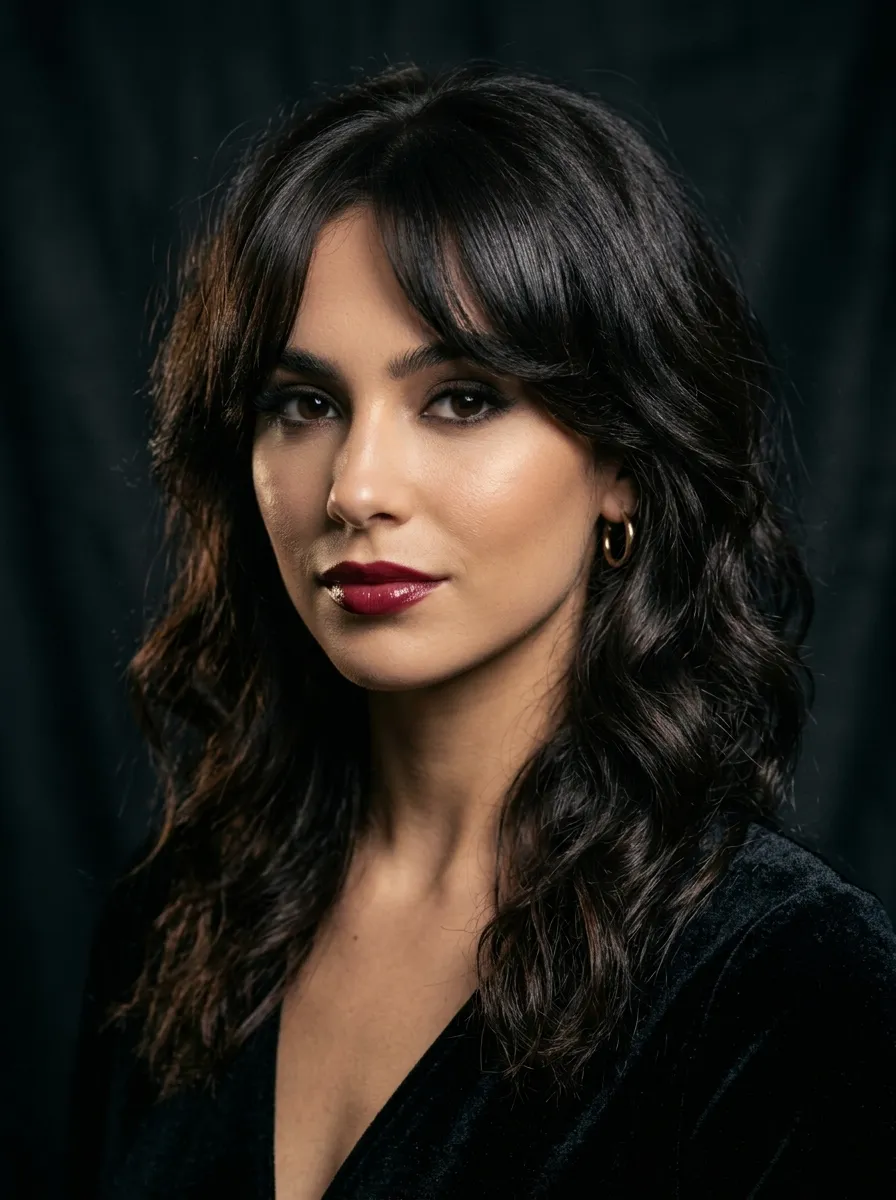
The wolf cut with bangs is usually associated with casual, daytime styling. But with the right finishing technique, it looks genuinely glamorous for evenings and special events.
The key is adding defined waves or curls to the wolf cut layers and finishing with a high-shine product.
Use a one-inch curling wand to add loose, defined waves section by section through the wolf cut layers. Wrap each section around the barrel and hold for eight to ten seconds. Release and let cool before touching.
Leave the bangs relatively straight or with just a slight bend at the ends. This contrast between smooth bangs and wavy layers creates a sophisticated look.
Once all the waves are set, run your fingers lightly through the hair to separate the curls into relaxed waves. Do not brush, as this will break up the wave pattern.
Apply a light-hold shine spray to add gloss without stiffness. This gives the finished style a polished, intentional quality.
Set everything with a medium-hold hairspray from a distance of twelve inches. Close application creates patches of stiffness.
The wolf cut holds its styled shape well for an evening because the layers have grip and body built in. You should not need to do much touching-up through the night.
Pair this styled wolf cut with bold earrings, a clean neckline, and a simple dress or blazer for a confident evening look.
21. Wolf Cut with Baby Bangs for an Avant-Garde Look
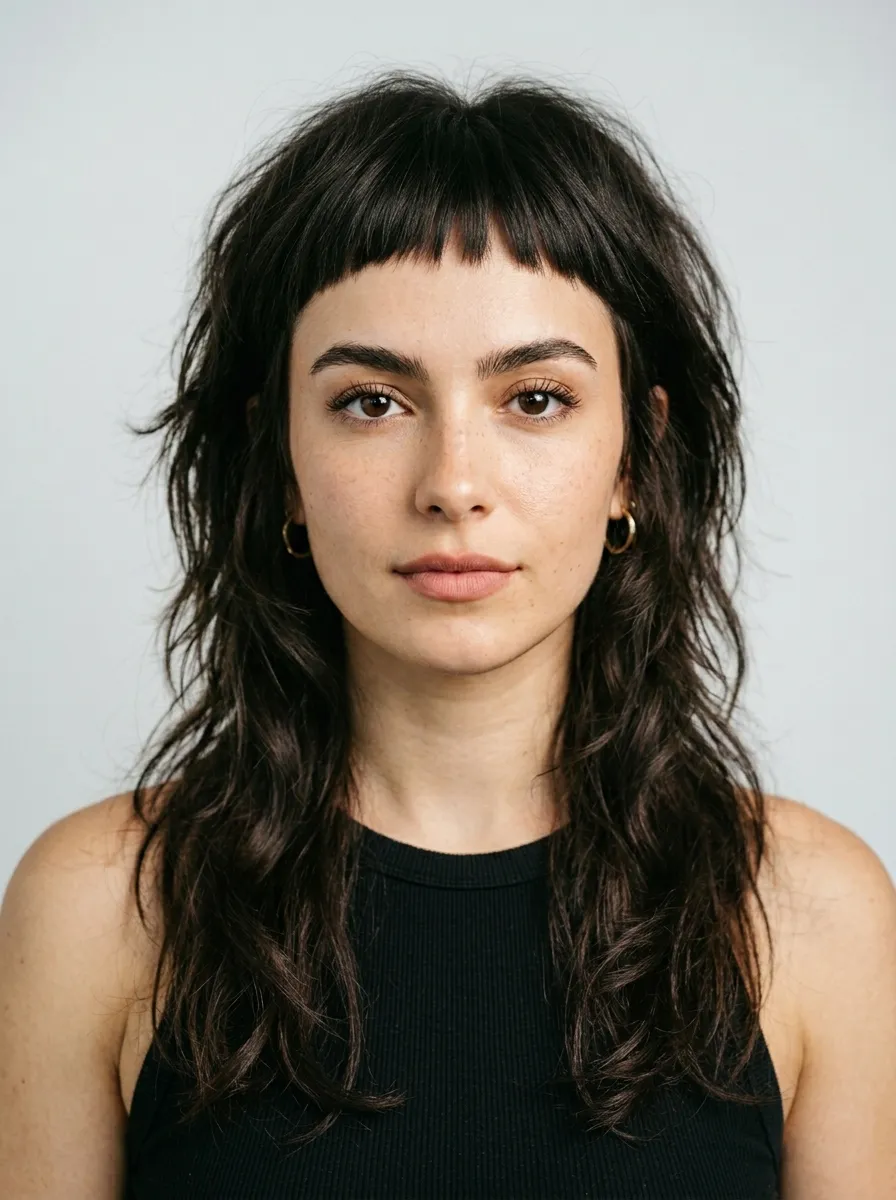
Baby bangs are cut very short, sitting just below the hairline at mid-forehead or even higher. On a wolf cut, they create one of the most avant-garde and attention-grabbing combinations possible.
This is a committed look. Baby bangs are very short and take a significant amount of time to grow out to a conventional bang length. Make this choice with full awareness of the maintenance phase ahead.
Baby bangs suit oval and heart-shaped faces most naturally. They draw significant attention to the eyes and forehead, which works beautifully when the face has balanced proportions.
The contrast between the very short baby bangs and the long wolf cut layers creates a dramatic visual tension that feels deliberate and artistic.
Ask your stylist for a consultation before committing. Bring clear reference photos and discuss your face shape to confirm this look will suit you.
Style baby bangs by simply blow-drying them flat against the forehead. Because they are so short, they require almost no daily effort to look neat.
They grow out relatively quickly in real terms, but because baby bangs start so short, even a month of growth looks noticeable. Plan for monthly bang trims to keep them at the desired length.
Pair this style with bold accessories and statement clothing. The haircut already makes a strong statement, so let the rest of the look match its energy.
22. Wolf Cut with Bangs for a Punk-Inspired Edge
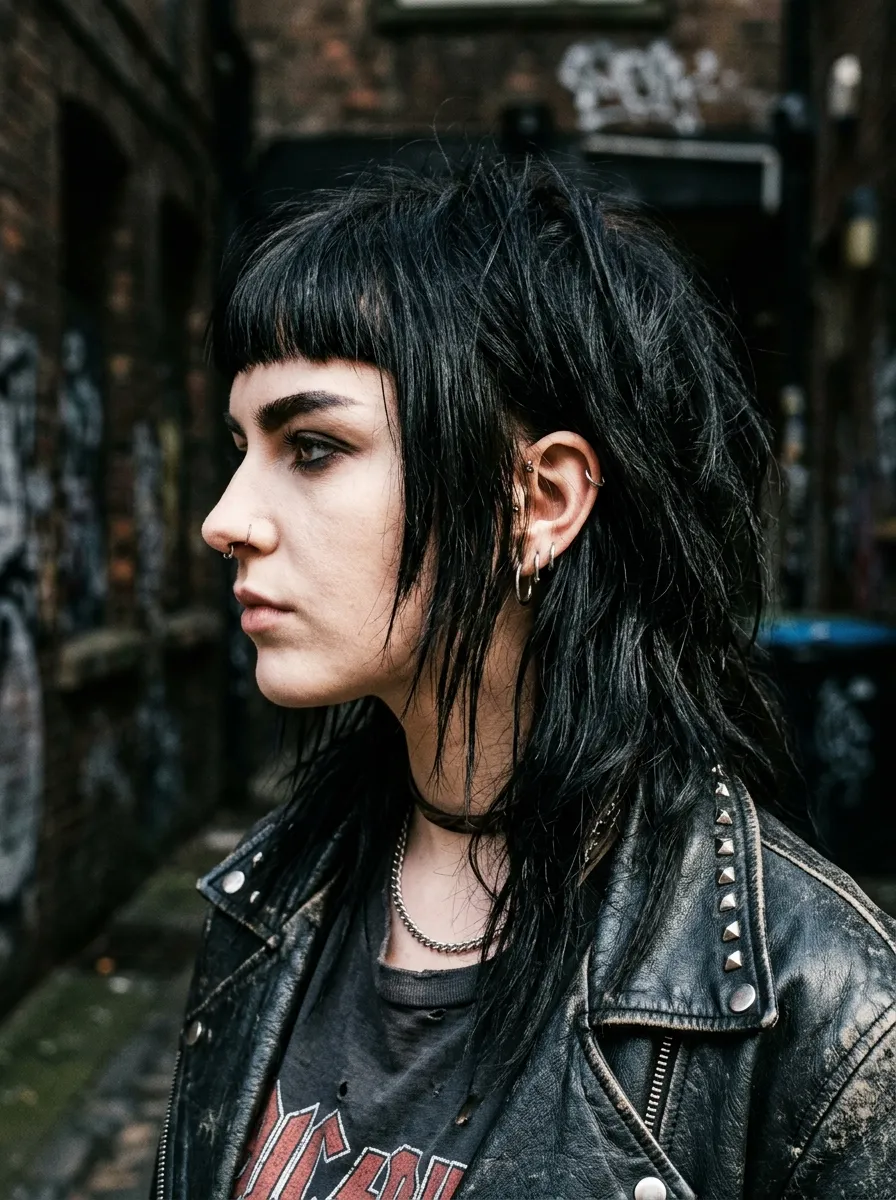
The wolf cut has always had a punk undercurrent. The shaggy, aggressive layering and the choppy ends are fundamentally anti-establishment in their aesthetic. Pairing this with bold bangs pushes the punk energy forward.
Blunt bangs, baby bangs, or heavily choppy bangs all suit the punk-inspired version of this cut. The less precise and polished the bang, the more authentic the punk quality.
Dark or vivid colors reinforce the punk aesthetic most strongly. Black is the classic choice. Deep red, electric blue, or bleached platinum all work equally well.
Ask your stylist to cut the layers aggressively and leave the ends with a jagged, fractured texture. This is achieved through heavy point-cutting and razor-cutting techniques.
At home, you can rough up the ends of an existing wolf cut with texturizing scissors to create more jagged separation between the layers.
Style this look by applying a small amount of strong-hold pomade or wax through the ends and using your fingers to spike and separate the layers.
Let the bangs fall where they want rather than carefully styling them into a perfect position. A slightly unkempt bang quality is part of the aesthetic.
Accessorize with silver hardware, layered chains, or simple stud earrings. Keep everything else understated so the hair remains the statement.
23. Wolf Cut with Bangs for a Soft, Feminine Take
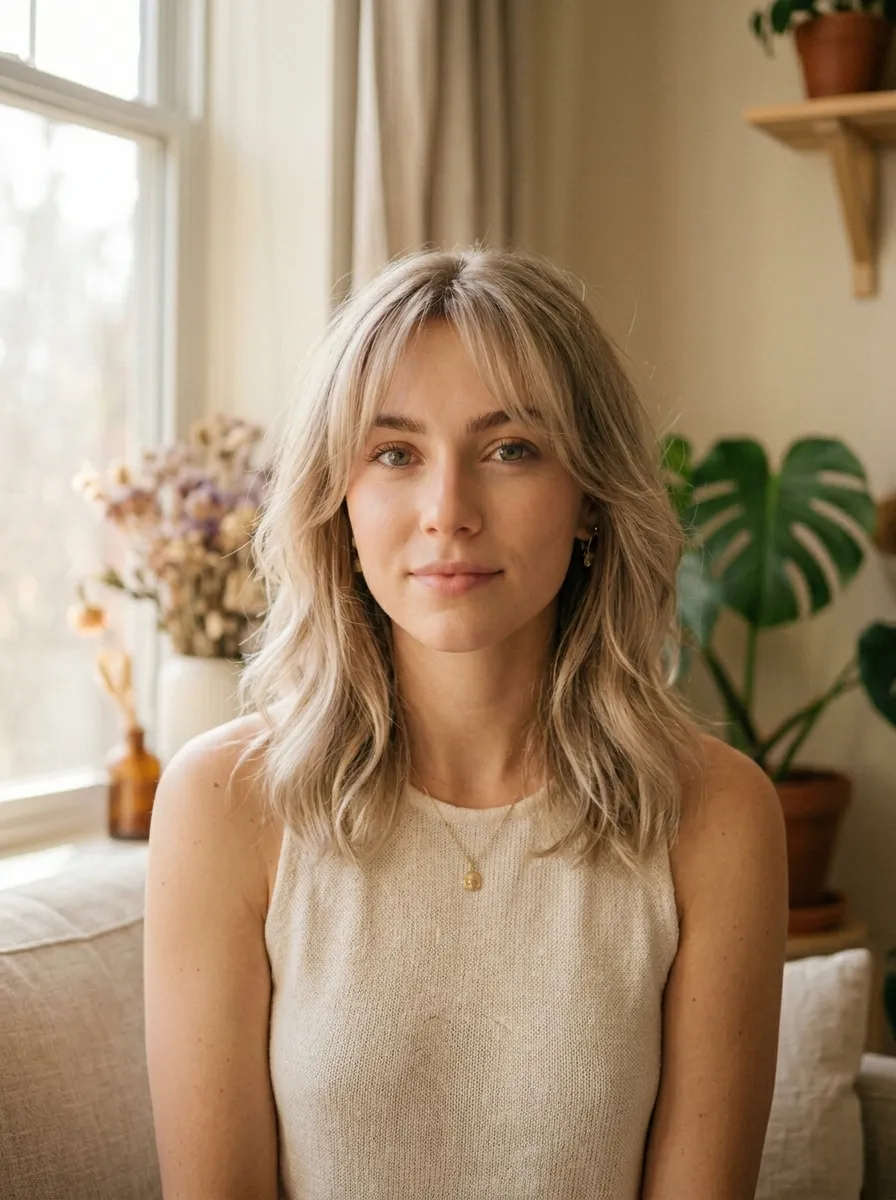
Not every wolf cut with bangs needs to be edgy or dark. A soft, feminine version of this style exists and is just as beautiful, just in a completely different direction.
The soft wolf cut uses gentler, more blended layers rather than harsh choppy cuts. The ends are still textured but in a more refined, feathered way rather than a deliberately jagged one.
Pair this version with long, delicate curtain bangs that feather softly and sit at cheekbone level. The gentler framing creates a romantic quality rather than an aggressive one.
Light hair colors suit the feminine wolf cut beautifully. Soft ash blonde, warm golden tones, rose gold, and champagne all give the cut an ethereal, luminous quality.
Style this version with a diffuser for soft waves or a large round brush for gentle volume. Avoid products that add too much separation or definition. The softness is the point.
A lightweight argan oil applied to the ends adds shine and controls frizz without altering the soft texture.
This is a wonderful version of the wolf cut for people who love the layered structure of the style but prefer a look that reads as elegant rather than raw.
It suits romantic dressing, soft color palettes, and anyone who wants their hair to feel like the most relaxed, beautiful version of itself every single day.
Conclusion
The wolf cut with bangs is one of the most genuinely expressive haircuts available right now. Whatever direction you want your look to go, there is a version of this combination that fits. The bangs change the entire frame of the face and give the wolf cut a front-facing focal point that makes the whole style feel intentional. Whether you go short or long, blunt or wispy, dark or vivid, the core of this cut always delivers: real movement, real texture, and a look that photographs beautifully and wears even better in real life. Take the ideas from this list to your next salon appointment with reference photos in hand. Describe exactly what you want, discuss what suits your face shape, and walk out with a cut that genuinely transforms how you feel about your hair. The right bang style paired with a well-cut wolf cut is one of the most confidence-changing combinations in modern hairstyling. Pick the version that excites you most and go get it done.
Leave a Reply